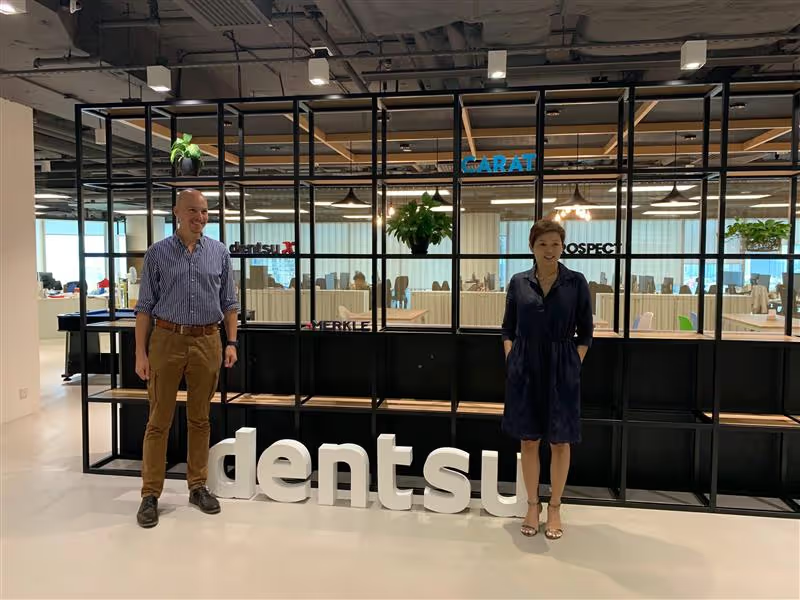
Agency pricing is under pressure from both directions at once. The retainers clients and agencies signed over the last few years assume the work gets made by people billing hours. GenAI now does a growing share of that production, so the hour counts underneath the deal no longer describe how anything gets made. Clients sense the gap and ask for AI efficiency discounts on hours that barely exist. Agencies cannot defend full-time-equivalent math when an agent drafts a deck in minutes.
The reset that tends to work prices deliverables and outcomes instead of hours, with quality assurance gates, revision service levels, and a priced verification line written into the scope. That helps whether you buy agency services or sell them. Trade commentary reported by StoryBoard18 in October 2026 describes the pressure on retainers as a structural reset in agency-client deals, and commentary by Maarten Albarda in MediaPost the same month urges marketers to stop asking for efficiency discounts and start buying deliverables.
Below I map what breaks, how good operators restructure scopes, what you can ask for without hurting delivery, and a Path A you can run this week. My examples lean on two decades of digital and commercial programs.
Why the retainer stopped matching the work
The deal structure is the problem, on both sides. A retainer converts hours into a monthly invoice. That structure made sense when the inputs were people and their time. Production has changed shape: agents now draft copy, cut variations, build decks, and summarise research, and a human directs, edits, and verifies. The invoice still counts the hours while the work arrives in a different unit.
 Photo: RDNE Stock project via Pexels, Petralian (2026)
Both sides signed the old deal in good faith. Clients committed budget for capacity, and agencies committed people against it. When production compresses, the client sees an input they are no longer getting, and the agency sees a cost base it cannot pass through at old rates. Nobody rigged anything. The unit of exchange stopped describing the work.
APAC raises the stakes. Branding in Asia reported in October 2026 that APAC CMOs are heading into 2027 with bigger budgets and higher AI expectations, which means more money moving under deal structures designed for hour-based production.
What breaks when hours disappear
Three things tend to break, and each one lands on both sides of the table.
The first is the efficiency discount. Clients ask for a percentage off the hours because AI is doing part of the work. The request makes sense from the buyer's chair, and the MediaPost commentary from October 2026 makes the counterpoint: the discount targets hours that no longer exist, so a cleaner move is to buy the deliverable. An agency that concedes the discount on top of old hour math funds the client's savings out of its own margin, which invites corner-cutting later.
The second is unbudgeted quality work. AI-assisted output needs human review, fact-checking, and revision cycles before it is safe to publish. In an hours-based scope, that review tends to get absorbed as goodwill because nobody priced it. Review capacity becomes the bottleneck while the commercial model keeps billing the old unit, a pattern I wrote about in the marketing engine series.
The third is trust erosion. When discounted AI output needs a human rescue late in the evening, the client remembers the rescue, and the agency remembers the discount that made it uneconomic. Each cycle makes the next negotiation harder. I have sat in enough delivery reviews to see the commercial terms as the usual root cause.
The reset: deliverables, gates, and verification
Adweek reported in September 2026 that Horizon Media president Bob Lord called headcount-based pricing "the old system" and predicted clients would stop paying for it within five years, and groups such as Publicis, WPP, Omnicom, and Dentsu all sit inside that shift. You do not need holding-company scale to structure it. Four components do most of the work:
- Deliverable scopes. Define the unit of sale as named deliverables with acceptance criteria, so both sides agree on what done means.
- Quality gates priced as lines. QA passes, compliance checks, and brand review become explicit scope lines rather than absorbed effort.
- Revision SLAs. State how many revision cycles a deliverable includes and what triggers a new one.
- Transparency and a verification line. Say where AI touches the work, and price the human verification that stands behind the output before it ships.
The table condenses the shift:
| Dimension | Hours-based scope | Deliverable-based scope |
|---|---|---|
| Unit of sale | Full-time equivalents and hourly rates | Named deliverables and outcomes |
| Efficiency pressure | Client asks for a discount on hours AI already compressed | Price was set on the deliverable, so tooling gains get shared through deliberate terms |
| QA and revisions | Often unbudgeted, absorbed as goodwill | Priced as explicit gates and revision SLAs |
| Verification | Rarely named | A verification line covers human review of AI-assisted output |
| Trust signal | Hard to audit what the hours bought | Scope states where AI touches the work and who signs it off |
Diagram: Petralian (2026).
I have argued before that media agency success needs redefining around new inputs; the pricing reset is the commercial twin of that argument.
Agencies face real margin pressure in this transition, since deliverable pricing moves production risk onto the seller. An agency that underprices verification will either lose money or quietly skip review, and both outcomes damage it. Buyers face a mirror risk: a scope squeezed to the minimum can be met with unverified AI output that looks finished and is not. The scope design has to price verification explicitly, or both sides absorb the waste in different forms.
Where AI production plugs into existing infrastructure
None of this requires a new platform layer. The composable logic that applies to enterprise AI applies here: small agent capabilities per workflow, connected through systems the client already paid for.
Two dimensions matter most. API-first: production agents should read the client's CRM, CDP, catalog, and reporting systems through existing APIs and events, so campaign numbers land in the same dashboards the finance team already audits. Cloud-native: delivery tooling should run where the client or agency already hosts, so the assets and the audit trail stay portable if the commercial relationship changes.
Keep the infrastructure that already works. Existing scope reporting, media transparency terms, and audit rights are assets, and a new AI production layer should plug into them. I covered the transparency side in my programmatic transparency post, and the logic carries over: if the AI layer replaces the reporting path, you lose the ability to check what you bought.
What buyers can ask for without hurting delivery quality
You can push hard on structure and still protect delivery. The safe asks mirror the reset above: deliverable definitions with acceptance criteria, written AI-touch and verification points, and revision SLAs priced as lines. One option for deeper alignment is an outcome or gainshare component, where part of the fee moves with the result.
Two asks tend to work against you. Stacking an efficiency discount on top of deliverable pricing pays the buyer twice for the same gain, and agencies that accept it may recover the margin elsewhere. Zeroing out the verification line looks like savings and usually converts into review debt you pay back during the campaign. Paying for verification is one of the cheaper trust purchases in an AI production deal.
Agencies carry their side of this too. Deliverable pricing means estimating, and estimates can be wrong. A good operator prices a buffer, states the assumption, and flags variance early rather than padding silently.
Path A: red-line one SOW this week
You can test all of this on one live document. Pick a current SOW or work order and set aside an hour.
Mark every line that pays for hours. For each one, note whether AI production has already compressed it, and by roughly how much. Draft the replacement line as a named deliverable with acceptance criteria, a QA gate, and a revision count. Add a verification line for the human review the deliverable needs, and mark where the AI tools touch the work.
Take the marked-up document into your next commercial review as a discussion draft rather than a demand. One red-lined SOW will tell you more about your book of business than a quarter of discount memos.
Limitations
The reported material here is trade commentary, not audited market data. StoryBoard18, MediaPost, and Branding in Asia reported the pieces I cite in October 2026, and Adweek reported the Horizon Media pricing comments in September 2026, but none of these give comparable figures on margin or outcome quality. Deal practice varies heavily by market, category, and agency size, so the patterns above may not map to yours. My experience base is APAC-weighted, and deliverable pricing is harder to operationalize than to describe. I have not seen a public dataset comparing retainer and deliverable-based scopes on quality or margin, so treat the table as a structural sketch rather than measured evidence.
FAQ
Are agency retainers going away?
Commentary reported by StoryBoard18 in October 2026 describes structural pressure on hours-based retainers, though retainers still work where output is genuinely continuous. What changes first is the unit of pricing inside the deal.
What is an AI efficiency discount?
A client request to pay less because AI does part of the work. MediaPost commentary in October 2026 urges marketers to move past these requests and buy deliverables instead, since the discounted hours often no longer exist.
What is a verification line?
A priced scope line covering human review of AI-assisted output before delivery. It funds the QA that keeps discounted production safe to publish.
Should agencies share AI-driven savings with clients?
One option is deliberate sharing through outcome or gainshare terms rather than ad hoc discounts. That way both sides agree in advance on how the gain gets split.
What should a buyer ask for first?
A deliverable-based scope with acceptance criteria, QA gates priced as lines, and a named verification line. Those four items expose where quality could quietly slip.
How does this play in APAC?
Branding in Asia reported in October 2026 that APAC CMOs head into 2027 with bigger budgets and higher AI expectations. More budget under old deal structures raises the bar for what a scoped deliverable has to prove.
Weekly email with new posts on enterprise AI and how teams ship it.
One email per week. Unsubscribe anytime.